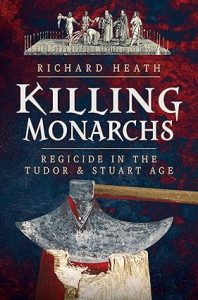
Richard Heath is the author of ‘Killing Monarchs: Regicide in the Tudor and Stuart Age’, which was published by Pen and Sword in September.
Richard’s previous works include ‘Charles V: Duty and Dynasty’ and ‘Henry VIII and Charles V: Rival Monarch, Uneasy Allies.’
Buy ‘ Killing Monarchs: Regicide in the Tudor and Stuart Age ‘:
Richard’s website: Emperor Charles V
Many thanks to Richard for answering my questions.

Why did you choose this subject for your book?
While writing about the relationship between Henry VIII and (Holy Roman Emperor) Charles V (2023), covering a period of over 30 years, it struck me that not many monarchs ruled for as long as these two. This motivated me to investigate why the reigns of so many others in Britain and Europe were cut short. It turned out that between 600 C.E. and 1800 C.E. 22% of monarchs died violent deaths, and that 70% of these monarchs (i.e. 15% of all monarchs) were deliberately killed by their own subjects. I wanted to explore this topic in the time that followed on from Henry and Charles, namely 1550 to 1650.
What does your book add to previous works covering this subject?
I always knew that the book would include figures more or less well-known in Britain (Lady Jane Grey, Mary, Queen of Scots and Charles I). However, I wished to extend it to include monarchs across Europe that would be less familiar to many readers. All have been written about before but not brought together into a single, manageable volume. It covers not just the historical background to each of the monarchs’ death, but also who the regicides (those responsible for the killings) were, what their motives had been, how they were able to carry out the killing, and whether their actions actually brought about the long-term goals that they had in mind. In this way, although each case has its own unique features, the book provides a broader understanding of the nature of regicide and its impact upon the country and its people.
How did you decide who to include and which regicide was the most shocking?
There were two main criteria for my decisions about who to include. I wished to investigate events in familiar or major states of the time (England and Scotland, France, Russia and the Ottoman Empire), not small city-states or principalities. I also wanted it to be representative of different types of regicide. Yes, these monarchs were killed in many different ways – beheaded, stabbed, strangled, shot or hacked to death. But what about the killers? There is a cast of religious zealots, self-interested nobles, family rivals, and those seeking to overturn the whole political structure. Some monarchs were murdered by a lone individual, others by groups close to the throne, often family members or disaffected nobles. Some were killed as a result of rebellion or widespread disorder, while still others were executed at the culmination of legal proceedings intended to secure the throne or bring into being a new form of government.
The most shocking? Difficult to say, because the shock may come from many different feelings. Injustice (Lady Jane Grey), the horror of an almost complete breakdown of government accepted as legitimate (Russia in its ‘Time of Troubles’ and France during the Wars of Religion), the sheer ruthlessness of the killing (Sultan Osman II in the Ottoman Empire and Feodor II in Russia) or the unrestrained lust for power (especially in Russia, with untrustworthy noblemen and various ‘pretenders’ to the throne).
What surprised you most researching this book?
Any student of history comes across a wide range of human behaviours, from the honourable and selfless to the duplicitous and shameful. All those in power are aware of how they might be viewed by their contemporaries and, perhaps even more so, by history. They want to influence and if possible, control this. What never ceases to surprise me (though it probably shouldn’t) are the lengths to which some people will go to try to justify their actions, and the level of deceit and even self-deception involved. Such behaviour comes through strongly in so many of the case studies in the book.
What were the motives of those behind the execution of Lady Jane Grey?
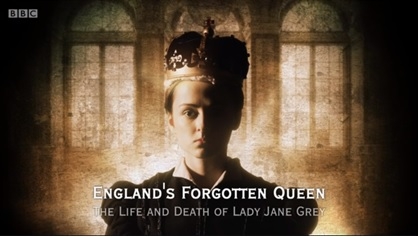
The execution of Lady Jane Grey was carried out not because she posed any immediate personal threat to Queen Mary, but because there was always the danger that she might become a figurehead for discontented subjects. She had a dangerous inheritance, as a great-grand-daughter of Henry VII, and grand-daughter of Henry VIII’s younger sister. Others had a better claim to the throne of England, but she was specifically named in Edward VI’s ‘Devise for the Succession’ as he neared his early death. He wanted to prevent his sister, Mary, returning the country to the Roman Catholic Church, and Jane was a convinced, articulate Protestant as well as a member of the Tudor family. She was the ideal, indeed just about the only, choice, because if Mary was to be disinherited as illegitimate, the same would apply to her sister Elizabeth.
Jane had never expected to be acclaimed queen. This attempted coup to prevent Mary’s accession in July 1553 quickly failed with the capitulation of John Dudley, Duke of Northumberland, and his subsequent execution. Jane, her husband, Guildford Dudley, two of his brothers and Thomas Cranmer, Archbishop of Canterbury, were sentenced to death in November 1553, but the executions were not immediately carried out. Queen Mary seemed reluctant to send Jane to her death despite the encouragement of others, including many in the Privy Council who had at first supported the coup, the new Catholic hierarchy in the church, and the ambassador of her cousin, Emperor Charles V.
What changed things months later was Mary’s plan to marry Philip II of Spain, Charles V’s son, and the subsequent rebellion of Sir Thomas Wyatt. Jane’s father, Henry Grey, Duke of Suffolk, was strongly implicated in the plot, although Jane herself, still in the Tower of London, had no knowledge of it. But her continued existence would be an on-going problem. Jane had been unwittingly used in the plans of others, treated as a scapegoat by those who wished to avoid condemnation, and let down even by her own father. Of all the monarchs killed during this period she had done least to deserve her fate.