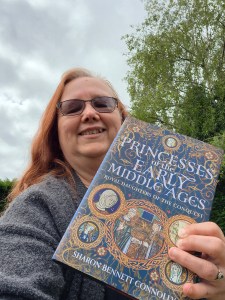
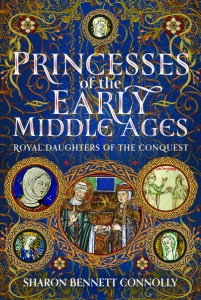
‘Princesses of the Early Middle Ages: Royal Daughters of the Conquest’ by Sharon Bennett Connolly was published by Pen and Sword on 30th March.
Sharon Bennett Connolly is a Fellow of the Royal Historical Society and best-selling author of 8 historical non-fiction books. As well as writing the popular history blog, http://www.historytheinterestingbits.com, Sharon co-hosts the podcast A Slice of Medieval, alongside historical novelist Derek Birks.
Sharon regularly gives talks on women’s history for historical groups, festivals and in schools; her book Silk and the Sword: The Women of the Norman Conquest is a recommended text for teaching the Norman Conquest in the National Curriculum. Sharon is a feature writer for All About History, Tudor Places and Living Medieval magazines and her radio and TV work includes the BBC and Australian Television’s Who Do You Think You Are?
Her latest book, Princesses of the Early Middle Ages: Royal Daughters of the Conquest, is book number 9.
Buy ‘Princesses of the Early Middle Ages: Royal Daughters of the Conquest’
Amazon.co.uk
Follow Sharon on Social Media:
Blog: History…the interesting bits
Podcast: A Slice of Medieval
Facebook: History: The Interesting Bits
X/Twitter: @thehistorybits
BlueSky: @thehistorybits.bsky.social
Instagram: sharonbennettconnolly
Many thanks to Sharon for answering my questions.
Why did you choose this subject for your book?
A couple of reasons. I kept seeing that meme on social media, you know the one: “My daughter wanted me to treat her more like a princess, so I married her to a stranger to strengthen an alliance with Poland”. And this is the image we have of a medieval princess, that no thought is given to their futures beyond creating a peace treaty. And I asked myself, is this true?
So, I wanted to explore the fates of the many princesses of medieval England and see how true the meme is. And, to be honest, yes, many royal daughters were married as part of peace negotiations. But there was more to it. And you can count on one hand the number of marriages, made in this way, that went awry. It turns out that arranging a marriage as part of a peace treaty meant there was a definite intention to keep things friendly from then on.
The other reason for the book was that there hasn’t been a book covering this topic since Victorian times. And that was Mary Anne Everett Green’s Lives of the Princesses of England, from the Norman Conquest. It was an epic six-volume book series, to be fair. And she was a South Yorkshire lass, like myself. But I thought it might be an idea to look at these women through modern eyes. And I thoroughly enjoyed the experience.
What does your book add to previous works covering these women?
Hopefully, it gives a new perspective of how the lives of these women were shaped, what their role was and what levels of influenced they achieved, not just in England but also in the lands they married into. Although I didn’t have their personal thoughts and feelings, I hope I have made them a little more 3 dimensional and highlighted that they were real women with real thoughts and feelings, and that they were not just pawns. That they had influence, both in the political and personal sphere of their lives.
Why did you decide to start the book with ‘The Last Anglo-Saxon Princesses?’
Ah, Gytha and Gunhild. They were not in the original draft of the book. But when I had to split the one book into 2 – because it was too long – from The Medieval Princess it became Princesses of the Early Middle Ages and Princesses of the Later Middle Ages, I had a few more words to play with. So, I thought, why not start with Harold II’s daughters? They led such interesting lives, after all – and they often get ignored and overlooked. And I am so glad I did! So many people have commented on how interesting that first chapter is!
What surprised you most when researching this book?
I think the most surprising thing is that these women were so much more than pawns, or pampered princesses. Or unwanted girls. Royal daughters had a purpose in life. A duty that had been instilled in them from an early age. They were the physical link between two nations, married to lords, kings and princes, to form an immutable family bond with every intention that permanent peace could be achieved.
They were daughters, wives, mothers, peacemakers, queens, ambassadors, diplomats and so much more!
Who was your favourite Princess to write about and why?
That is easy! My favourite is Joanna Plantagenet, Queen of Sicily and Countess of Toulouse. I have had a soft spot for Joanna for a long time. She led such an adventurous life – although not always of her own choosing. She faced so many challenges, was imprisoned after her husband’s death, so his successor could keep her dowry. Being rescued by her brother, Richard the Lionheart, was not as chivalrous as it first appears. He had her dower lands translated into cash and then added the cash to his crusading funds, leaving Joanna with no option but to follow him to the Holy Land. He then suggests her as a bride for Saladin’s brother as part of peace negotiations. Joanna put her footy down and flat-out refused.
After all that, she deserved to live happily ever after. But her second marriage, to Raymond of Toulouse, was far from being all sunshine and rainbows. She left him, though she was heavily pregnant, and died in childbirth shortly afterwards.
Ok, so not the happiest of stories. But what drama!