As part of the 25 year’s celebrations, I am delighted to have interviewed Lee Porritt.
Lee is the creator of Lady Jane Grey Revisited where he posts his investigations into the iconography of Lady Jane.

Follow Lee on Social Media:
Website: Lady Jane Grey Revisited
Facebook: Lady Jane Grey Revisited
X/Twitter: @GreyRevisited
Instagram: Lady Jane Grey Revisited
Many thanks to Lee for answering my questions.
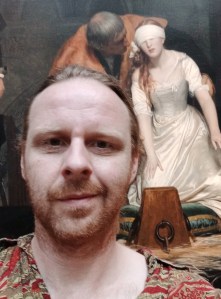
When did you first get interested in Lady Jane?
Lady Jane has been a part of my life for as far back as I can remember. I don’t recall what it was that captured me about her story, however, what I do remember is that I instantly wanted to know more. As a child, I was very creative and struggled with reading and spelling during my school years. I was diagnosed with dyslexia quite late in life; however, I never allowed this to interfere with my love for history, and I would often enjoy looking at pictures of old portraits in history books.
Jane is today famous for her love of learning, and when I think about it, I have a lot to thank her for, as she enabled me to learn. One of my earliest memories is having her story read to me from a book entitled “Discoverers and Adventurers” by R.J Unstead. From that moment on, I was completely gripped. I spent many hours in my local library attempting to discover all I could find, at my own speed, often reading things slowly, with occasional assistance from the librarian. It is difficult to explain, but Jane was my safe space. I became familiar with the wording used to tell her story, which helped me to read other published material, and allowed me to read faster over time. During my school years, Jane was my first point of call when having to present research projects or read out loud in a dreaded English lesson.
I suppose one of the many things I like about Jane, is that even today she continues to be a complete enigma, and many have different opinions about her. As much as we try to establish what we think we know about her, the real Jane is often just out of our reach. Although, she has often been a subject in art, and her story has travelled down the centuries in written format, we have seen many different characters over the course of time. During the seventeenth century, Jane was often favoured for her education and portrayed as a religious martyr, who would rather die than convert to Catholicism. In the eighteenth century, Jane was characterised as a devoted wife who was in love with her husband, and it was Guildford Dudley who finally persuaded her to accept the crown. By the nineteenth and twentieth century Jane would take on several fresh façades in which we see her as a reclusive, quiet, and obedient character, who was often found reading, and preferred to wear plain attire. This brings about the question as to why she has changed so much? In truth, only a small handful of documents that mention Jane’s name have survived from the sixteenth century. The quantity of documents and items owned or written by Jane herself is even smaller, and many of these provide fragments of details regarding the real person whose story has captured audiences for generations. This has allowed some of our earlier writers to fill in the gaps, and she has often been changed and adapted to fit in with what was culturally significant to the writer during the period she is being discussed.
What is your favourite representation of Jane and why?
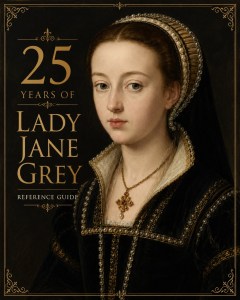
All of them, I find them all so interesting. In terms of her portraiture, we often forget that each painting has a story and everything is a clue. Although we currently have no surviving contemporary portrait of Jane today, many portraits supposed to depict her have been listed in inventories, private collections, and auction catalogues over the course of time. What we often see when we look at each of the paintings as an historical object is that the conclusive evidence is missing or is slightly too late, the portrait has been overpainted during a later period, or her name has simply been attached to a portrait that presents a similar image of what people thought Jane was like at that point in time.
What I again find interesting about this, is that for hundreds of years the public, including myself, have wanted to know what Jane looked like. The demand for her image has always been popular, and we just need to look at the substantial number of printed images of Jane that have been produced over the centuries to prove this point. In recent years, research information regarding NPG 4451, the Streatham Portrait, and the Wrest Park Portrait, all supposedly depicting Jane, have been widely publicised in the news. This again demonstrates that the demand for her image continues to this day. Similar to written depictions of Jane over the course of time, she has appeared in the visual arts in one shape or form, however, has disappeared when further investigation has taken place. This again feels like Jane, herself, is playing a game of cat and mouse with us, as that demand to know more about her, and come face to face with the real Jane continues to remain just out of our reach.
Is there a missing portrait that you would love to find?
I would have to say the Chatsworth portrait, as it is probably the one that has the closest connection to Jane. However, I am always happy to come across any portrait that has, or has had a previous documented link to Jane, as I love nothing more than a good investigation.
When discussing the Chatsworth portrait, we need to acknowledge the fantastic work produced by Dr John Stephan Edwards regarding Jane’s iconography. It must also be acknowledged that my website was started as an ‘add on’ to the lost portraits chapter discussed in his book ‘Queen of a New Invention: Portraits of Lady Jane Grey/Dudley, England’s Nine Days Queen’. As we see from his book, Dr Edwards has completed a detailed investigation into the portrait of Jane listed in the 1560 inventory of the personal possessions of Bess of Hardwick. We do know from the inventory that the portrait of Jane was listed in the bedchamber of Elizabeth Cavendish, who was a close friend of the Grey family, and would have known what Jane looked like. We don’t know for certain if the portrait of Jane listed was taken from life. However, due to the personal aspect in which the portrait was displayed in the home of someone who knew her, we can presume that it was a reasonably good likeness of her.
As discussed above, Dr Edwards has completed a thorough search for this missing portrait and concluded that it was probably destroyed due to its neglected state. We do live in hope that by some miracle the Chatsworth portrait has managed to survive, however, if this painting was ever going to be found, then I am more than one hundred percent certain that Dr Edwards would have found it by now.
What is your favourite discovery in your investigations in gallery/auction archives?
This is a difficult one as I have so many. Anyone who has visited my website and read my work will see that it no longer just focuses on Jane. During my search of the various archives, galleries and auction catalogues I have come across a range of interesting things related to the iconography of many of our Tudor figures. Over the years, I have gone off track a little, and published work related to portraits of Queen Elizabeth, Catherine Parr, Queen Mary and of course Anne Boleyn. I like to discuss lesser-known portraits, as much has been written about a lot of the famous sixteenth century paintings from prominent galleries and private collections, and I don’t like to run the risk of just repeating information that has already been discussed.
I suppose when it comes to the subject of Jane, some of my favourite discoveries were managing to locate some of the lost portraits from Dr Edwards list, and a small number of portraits that had not even made the list. I had followed Dr Edwards work from the start, and as discussed above, he is very thorough when it comes to Jane. I was very honoured that I was able to add to his research in a small way, and study some of the paintings that did not feature in his book. Of the sixteen portraits currently discussed on my website concerning Jane, I would have to say the Crozier Portrait was probably the most fascinating of finds. On further investigation the portrait had been hiding in plain sight all these years and turned out to be NPG764, which was thought to depict Jane for a long period of time.
The discovery of William Frederick Yeames lost painting of ‘Lady Jane Grey in The Tower’ was also a high point for me. I have a fond memory of seeing the painting for the first time and was so pleased that Yeames opted to change his image of Jane for the final composition. I had never really been a fan of the rather stiff and dark preparatory painting in the collection of Weston Park Museum and the completed version is beautiful.
From a personal point of view, one of my favourite discoveries was that I started the website at all, and that the little boy discussed above who struggled to read and spell had the courage to put his thoughts on the internet for all to read. When I first started Lady Jane Grey Revisited, I honestly thought that no one would bother to read it. I was so surprised to see that the articles were being viewed, commented on, discussed, and even cited in other published work. Once again, my safe space with Jane had enabled me to push myself forward, learn, and develop my skills.
Do you think that any of the missing portraits were painted during Jane’s life?
I do, yes. As discussed above, I do think the Chatsworth portrait is highly likely to be a portrait painted from life. Jane was a member of the royal family and would certainly have had access to the funding to pay an artist to paint her portrait. She also lived during a time where it was becoming popular to have a portrait painted as a sign of status, to celebrate a skill and achievement, or to send as a gift. We do have documented evidence regarding other members of the royal family commissioning and sending portraits out as gifts, and I very much doubt the Grey family would have resisted this.
The fact that Bess of Hardwick is documented as owning an image of Jane, within years of her death, that she deemed important enough to display in her bedchamber is also a tantalising clue that Jane did have her portrait painted, or an early pattern was known to exist. Sadly, when it comes to the Grey family, little in terms of confirmed iconography survives today, however, this does not necessarily mean they did not have their portraits painted. No inventories, account books, or payment slips have survived to provide that in-depth knowledge about the family’s daily life. Many of the properties they resided in where abandoned and fell into disrepair during later periods. It is highly likely that the contents of the properties they resided in would have also fell into disrepair or would have been sold off and scattered around the country without little knowledge of their potential historical significance.
Going back to the previous question, we need to remember that the sixteenth century portraits we see online and in books today, is nothing but a fragment of what is, or was, out there stored in private collections at some point in time. Many of our archives contain boxes full of photographic images or other tantalising clues of sixteenth century portraits that have not been published or studied at all. However, the task of establishing the identity of a sitter is a complex one, which takes time, and can cost a lot of money when having to travel from one place to another for further research. That being said, I do find portrait research a remarkably interesting and exciting subject. As we have seen from recent years, the research into our early portraiture is continually changing, adapting, and new discoveries and theories are being published frequently. It would be nice to say, that maybe one day Jane will stop slipping through our fingers, and we will come face to face with a confirmed likeness of one of history’s most elusive characters.